 Nix McRetro
I had a request for some help on getting MIX4AAE working on a flash cart. So I figured sure, why not! :)
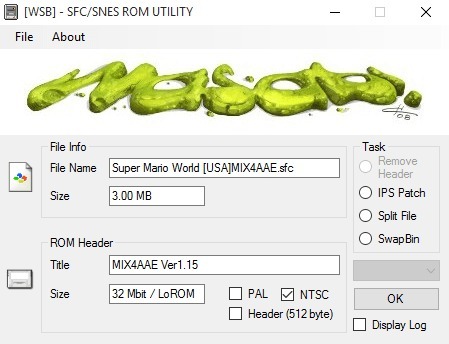
First up we take the Super Mario World (US) ROM which weighs in at 512 kB, making it a 4 Mbit ROM. Then apply the IPS patch from the link above. I used the good old reliable SFC/SNES ROM UTILITY V2.1 under Windows 10. I couldn’t get MultiPatcher 1.5 to patch correctly on the Mac side, so quickly gave up on that.
Open the Super Mario World (US) ROM in the utility. It reports a 0.5 MB, 4 Mbit NTSC LoROM. Select the IPS Patch option and choose the MIX4AAE IPS file. In my original walkthrough I answered Yes to the headered-ROM prompt; that choice needs to match the patch and source ROM, rather than being a universal Yes. The patched file grows to about 3.00 MB, which is 24 Mbit of data. It still fits comfortably inside the 32 Mbit / 4 MB AM29F032B or M29F032D flash chips I was using.
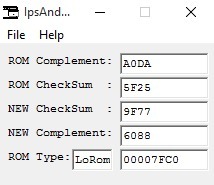
For the sake of being complete, we’ll also fix up the checksum. No one likes a dirty checksum. I used IpsAndSum. Open the newly patched file, select “Repair Snes CheckSum”, accept the repair prompt and save the resulting ROM.
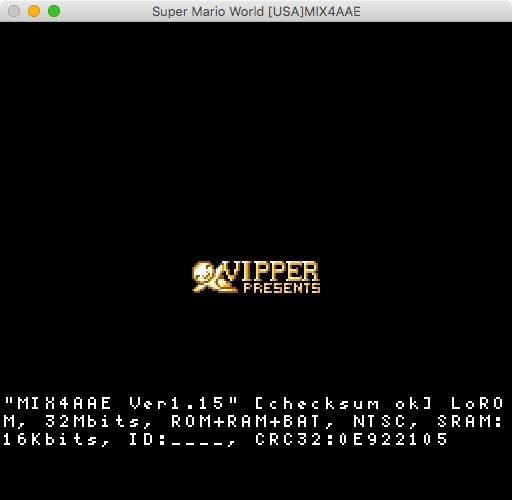
Now fire up an emulator to test that the patched ROM actually works. I used Snes9x 1.53 on the Mac. It also reported the information I needed for finding a suitable donor cartridge:
- LoROM
- 32 Mbits
- NTSC
- SRAM: 16 kbits
- Battery
That 32 Mbit value is what Snes9x reported from the ROM metadata. The patched file itself is still about 3.00 MB, or 24 Mbit of actual data.
The original mask-ROM capacity is not the main concern once we’re replacing that ROM with a larger flash device, but the donor PCB still matters. The board needs the appropriate LoROM mapping and save-memory hardware for the patched game, including suitable SRAM and battery support where required.
The old SNES PCB List-full.xls was useful for comparing donor boards. The current files page is a placeholder, so the spreadsheet still needs recovering.
You could technically use a Super Mario World cart. For other candidates, check that the PCB layout, mapping and save hardware suit the patched game.
Once you find a suitable donor cart, also make sure the region matches or use appropriate region-modification hardware.
From there it is a matter of getting the ROM data onto the TSOP flash chip and installing it in the cartridge. It is more complicated than it sounds; these videos might help.
This first video shows part of the ROM flashing process using EarthBound as an example. EarthBound is a 24 Mbit game that fits inside a 32 Mbit TSOP40 flash chip.
The second video is a guide to soldering the TSOP device itself. At the time, I was planning a follow-up on programming.
January 2020 Edit: A later write-up from The Poor Student Hobbyist also goes through SNES reproduction-cartridge construction in much more detail, with several board and chip options.
And of course, remember to have fun! Good luck! :)