 Nix McRetro
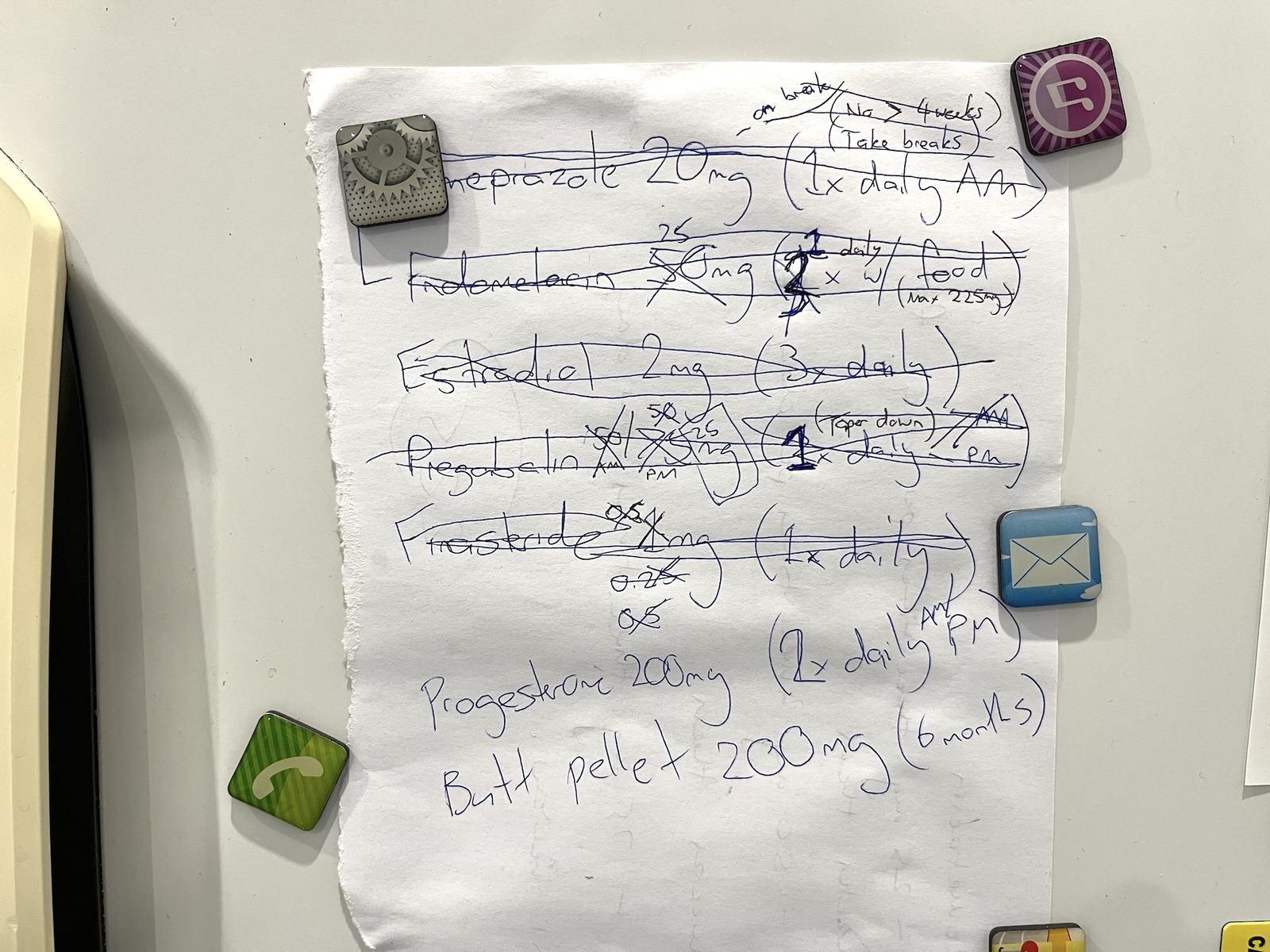
A few milestones have been achieved this month. I’ve reached my third month of gender-affirming hormone therapy (GAHT) and was able to get an estradiol implant (200mg, compounded). I stopped pregabalin because it wasn’t helping my anxiety symptoms, although it had helped with sleep. I also ceased indometacin successfully. Hemicrania continua is not being so continua now. These are my historical medication changes; changes like stopping pregabalin need to be worked through with the prescriber.
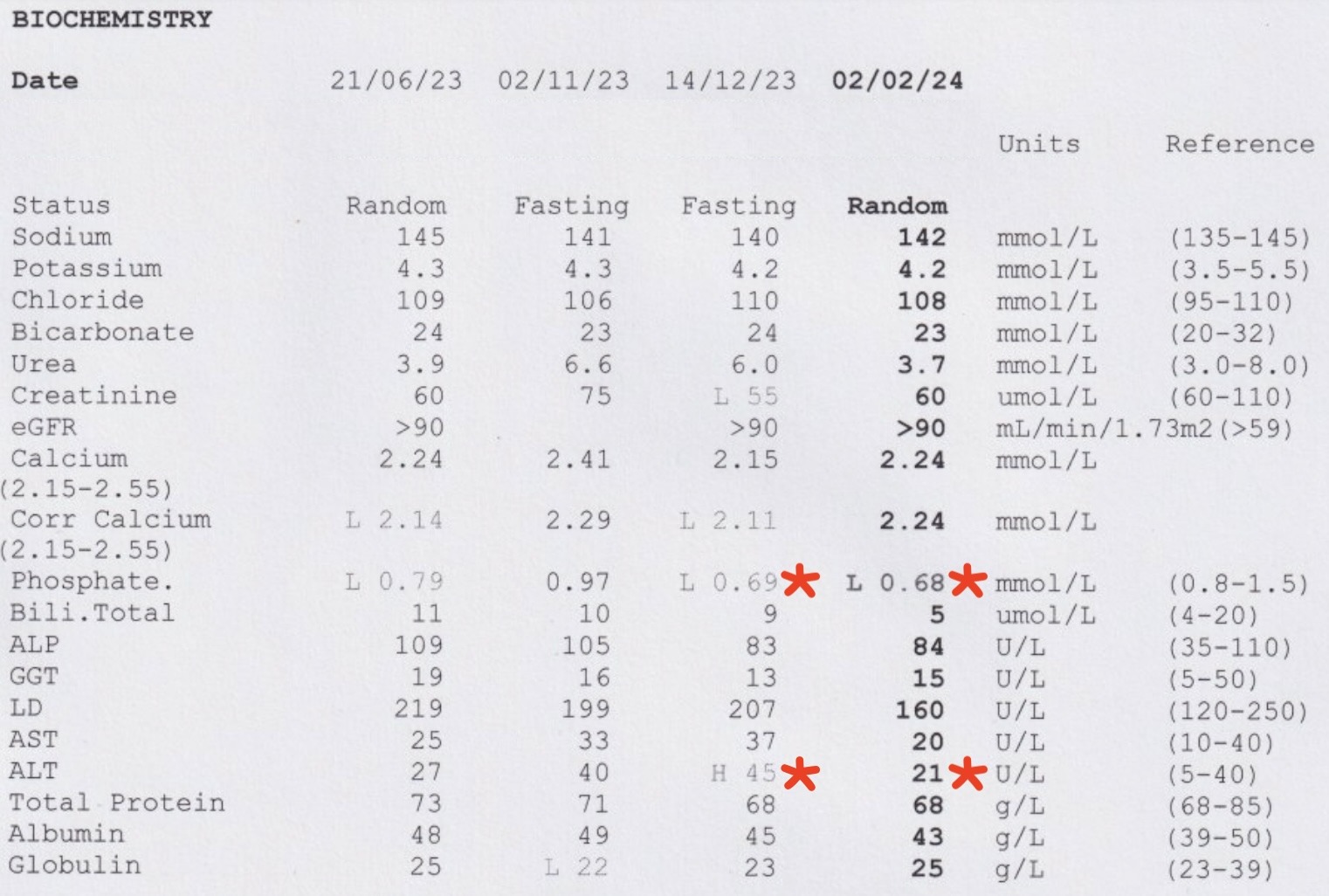
My phosphate, calcium and ALT levels. Ahhh yes. Let’s start with the ALT. Mine fell from 45 to 21 U/L after I ceased indometacin. That fits with the drug being a possible contributor, but the timing alone doesn’t prove the cause. I also took milk thistle hoping to keep the old liver in tip top shape - with some theories about interesting consequences. I’ll circle back to that!
Phosphate and calcium: I wondered whether the lower numbers were necessarily a bad thing. An ionised calcium test was ordered and came back in range, as did the other calcium results this time. I’d changed my calcium supplement to a non-plant-based formula because I don’t drink milk. Calcium was OK on this test; that doesn’t show that the supplement change caused the improvement.
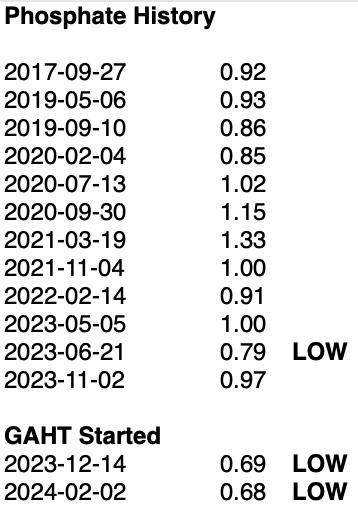
Now phosphorus is in plenty of foods, but a low blood phosphate result doesn’t tell me whether intake, absorption, losses or something else is responsible. Thanks to my history of low iron, phosphate had often been ordered alongside the other tests, giving me a decent run of results to compare. I tended towards the lower side, with new lows after starting GAHT. I went looking for possible explanations in a spirulina study and the MESA estrogen study.
My theory was that the spirulina in my multivitamin might be involved, or that the hormone changes were playing a part. But the spirulina paper studied diabetic rats, and the MESA paper studied postmenopausal women. Neither establishes what my multivitamin or GAHT did to my phosphate. Low serum calcium or phosphate is not, by itself, evidence of improved bone density. Then we have this potato of a gem from the second article:
Estrogen therapy (ET) is associated with lower serum calcium and phosphorus concentrations and is known to increase bone mineral density (BMD).
Estrogen has an important role in maintaining bone health, which helps explain why bone loss can become an issue after menopause. That doesn’t make low phosphate a good result, or establish progesterone as a bone-protection treatment for me. The article gave me something to read and discuss, rather than proof my bones were getting denser. We’ll be rechecking in three months.
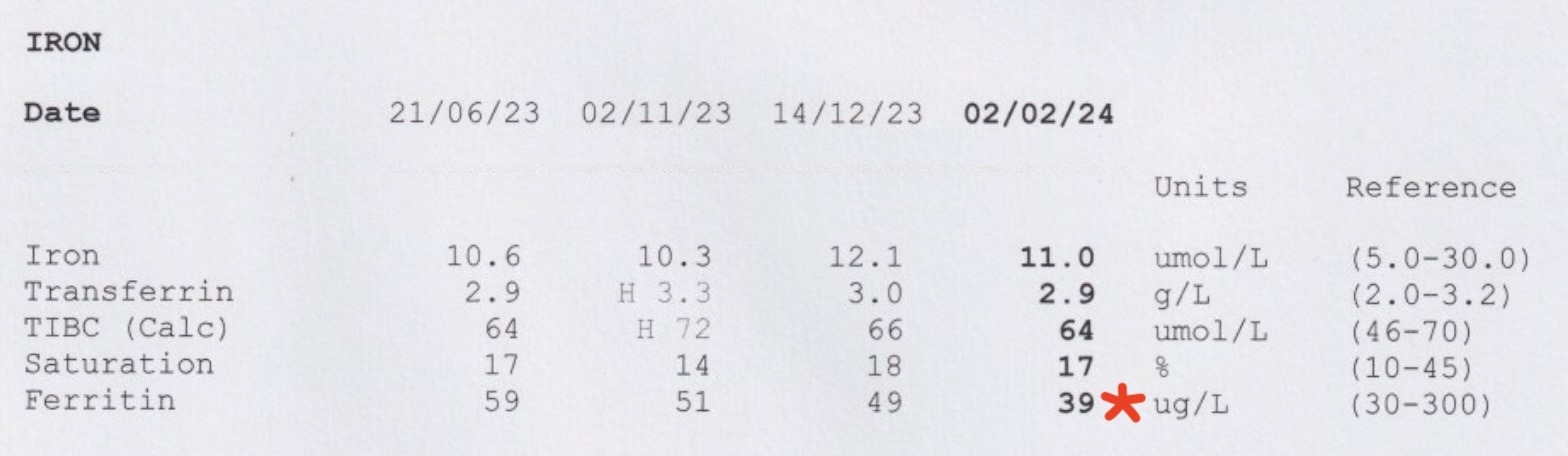
Oh iron, sweet, sweet iron. Each blood test takes about five vials of blood, and my ferritin had slipped from 59 to 39 µg/L across these results. I’d stopped donating blood, but that didn’t rule out depleted stores from earlier donations or other causes. Diet was another possibility, not an answer I could establish from this panel. My plan at the time was 210mg of elemental iron every other morning, one hour before food. That records what I intended to take, not a dose for anyone else to copy; the cause and treatment need to be worked through with the clinician.
I had the hepcidin explanation muddled. Hepcidin is a hormone, not an enzyme, and oral iron can raise it for roughly 24 hours, reducing absorption from another dose soon afterwards. That is part of the rationale for alternate-day dosing in the studies I was reading. Vitamin C can help with non-haem iron absorption, but it doesn’t simply override hepcidin; a clinical trial found similar outcomes with oral iron alone and iron plus vitamin C. I also hoped fewer dosing days would mean fewer GI side effects. Roughly half the issues? That was my hope, not a guaranteed calculation! 😅
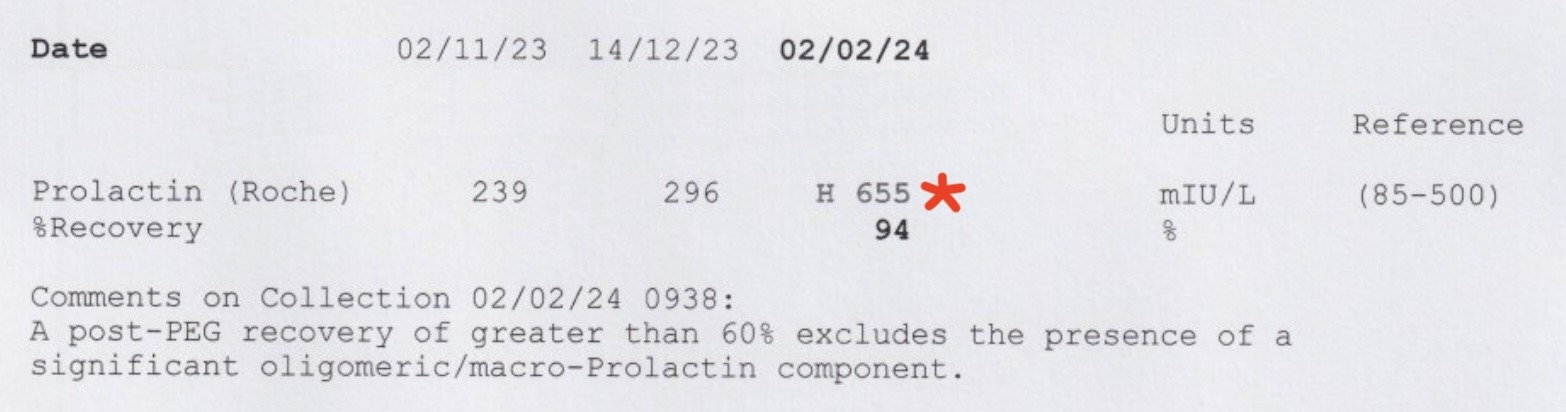
Onto hormones! Errrrr… why did prolactin more than double, from 296 to 655 mIU/L, and zip outside the laboratory’s 85-500 range? My GP wasn’t sure why, and my endocrinologist wasn’t concerned at that level. I had understood their explanation as not being an issue unless it was roughly triple that number, but that isn’t a universal threshold. Pregnancy ranges weren’t a useful yardstick for deciding what my result meant. It was something to interpret with the clinician and follow over time.
So what caused mine to spike? I wondered whether it was the milk thistle I’d taken while worrying about indometacin and my liver results. I’d been reading Healthline, a Reddit discussion and the idea of a galactagogue. Those weren’t proof. LactMed reports no human data establishing milk thistle’s effect on serum prolactin. I’d ceased it and wanted to see the next test, without assuming the number would fall. Hold up, I was just reading this again:
In animals, milk thistle has been shown to stimulate bone mineralization. However, how it affects humans is currently unknown.
Hmmm, I wondered whether my calcium and phosphate levels would also change without milk thistle. I’d only taken it for two weeks, and the bone-mineralisation finding quoted above was from animals. Something to look at on the next test, not a mechanism I’d demonstrated in myself.

Ahh yes, traditional sex hormones. Some of the more interesting results to look at. I aimed to have blood taken before the next dose so the timing was consistent. That can approximate a trough for a regularly dosed medicine, but doesn’t guarantee every hormone is at its absolute lowest, especially when tablets, gel and implants have different release patterns.
On 6mg oral estradiol valerate (2mg three times daily) and estradiol gel (Sandrena 0.1%, 1g sachets twice daily), I scored a lovely 764 pmol/L. Previously, with pill therapy alone at 6mg, it came in at 364 pmol/L. A decent jump after adding gel, although a single comparison isn’t a controlled test. I now have two compounded 100mg pellet implants in my left buttock for 200mg of estradiol. It’ll be interesting to see how that settles over the next three months. These are the preparations and doses in my own treatment history, rather than interchangeable ways to dose estradiol.
On the progesterone (P4) front, I’d come across the idea of waiting around 12 months after starting estradiol. My endocrinologist didn’t see an issue with starting earlier. Evidence for adding progesterone to feminising GAHT was limited, and there wasn’t an established universal 12-month rule. Comparing the timing with puberty doesn’t settle what will work for me. Past performance may not be indicative of future performance.
For me, progesterone felt like a counterweight to the estrogen. With it in the mix my skin seemed less dry, which had been one of my biggest gripes about estrogen monotherapy. That’s what I noticed, rather than proof that progesterone is necessary to balance estrogen or that higher estrogen doses are better.
At least one of progesterone’s metabolites, allopregnanolone, is a neurosteroid that modulates GABA-A receptors. That caught my attention because alcohol and benzodiazepines also affect this system, although they aren’t interchangeable. Pregabalin works differently: it binds to alpha-2-delta subunits of voltage-gated calcium channels, rather than directly to GABA receptors. An interesting collection of pathways, but not something I could read off my progesterone result.
Oh I could ramble on for days about this sort of thing. Let’s look at the level itself: 9.1 nmol/L, taken about 12 hours after the last dose. That’s a snapshot of my treatment, rather than a score I can grade by matching it to a menstrual-cycle phase. I had since doubled the dose on my endocrinologist’s recommendation.
There are other routes of administration (ROA) for progesterone, butt (ha!), I wasn’t going to assume my compounded powder capsules could be used that way. Formulation and route matter, and that’s something to check with the prescriber and compounding pharmacist. I’d been considering a different commercial preparation, but the cost put it off my radar at that point.
Converting my 9.1 nmol/L to US-friendly units gives about 2.9 ng/mL, not the 2.6 I’d originally calculated. It helped me compare the number with the charts in Transfeminine Science’s oral-progesterone review. Different routes can give different progesterone and metabolite profiles, but those charts don’t establish the right route or dose for my particular preparation.
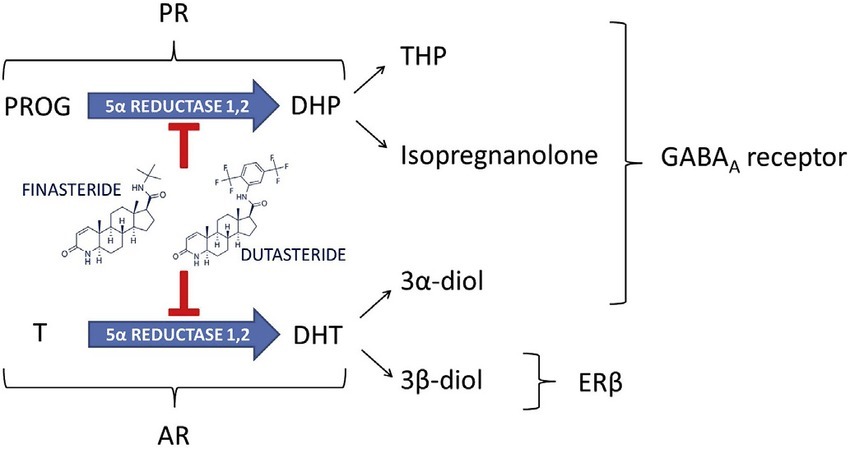
Which leads us onto finasteride, a 5-alpha-reductase inhibitor (5ARI). It inhibits the enzyme that converts testosterone (T) into dihydrotestosterone (DHT). That is different from blocking testosterone production or blocking the androgen receptor itself.
DHT can contribute to androgenetic hair loss when the follicles are susceptible. As a transgender woman, I don’t really want to be bald if I can avoid it, so I’d started finasteride early on. I had also been reading about progesterone and the same enzyme pathways, but that doesn’t make progesterone a proven substitute for finasteride. Inhibiting 5-alpha-reductase can affect the production of several steroids, rather than just DHT.
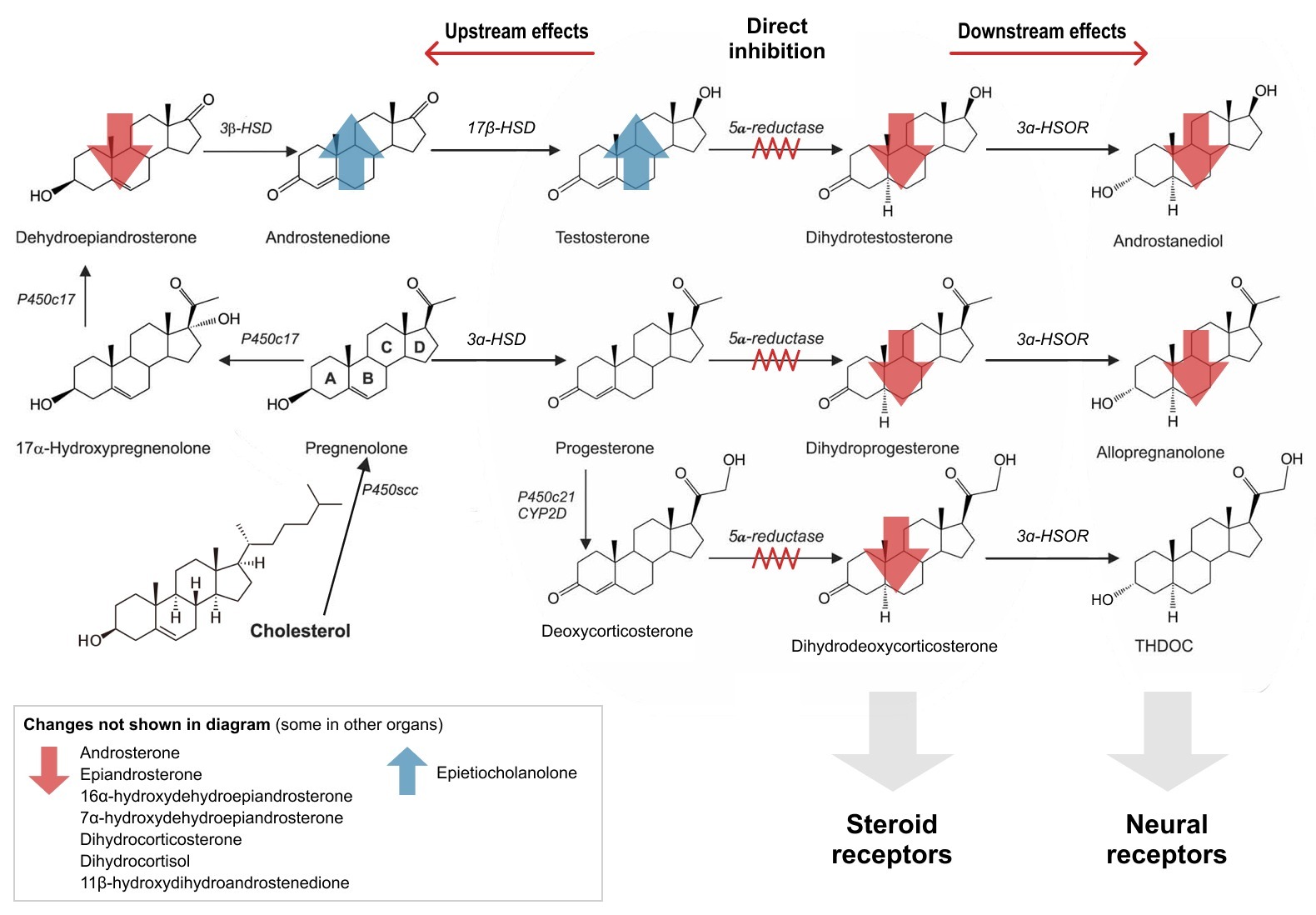
Remember our little friend allopregnanolone from earlier? The pathway diagrams show why inhibiting 5-alpha-reductase can affect progesterone metabolites too, including pathways leading to isopregnanolone. The review I was reading discusses these wider effects. It doesn’t show that my own metabolite levels were completely blocked, or that every user has the same outcome. Finasteride was feeling like quite a dirty drug to me, but these are potential downstream effects of the enzyme inhibition, not proof it randomly hits lots of unrelated targets.
I’d decided to stop finasteride and wasn’t taking testosterone blockers such as cyproterone acetate or spironolactone. I was calling my goal “estrogen dominance”: my shorthand for the hormone profile I wanted, rather than a clinical diagnosis. Suppressed testosterone can reduce the need for a testosterone blocker, but finasteride’s possible role in hair loss is a separate question to discuss with the clinician.
It is unclear if there is any added benefit to taking one of these medicines once your testosterone levels have been reduced into the female range through the use of other blockers.
The science behind it all is always a work in progress. For now, the useful question was whether my treatment, symptoms and blood results were moving towards my goals. “Estrogen dominance” wasn’t a reason to chase the highest estrogen level I could get.
If DHT contributes to my hair loss, what happens after I cease finasteride? Will it resume? These blood results can help show how testosterone is responding, but they don’t directly measure DHT or guarantee what happens at the hair follicles. That’s a question to follow over time.
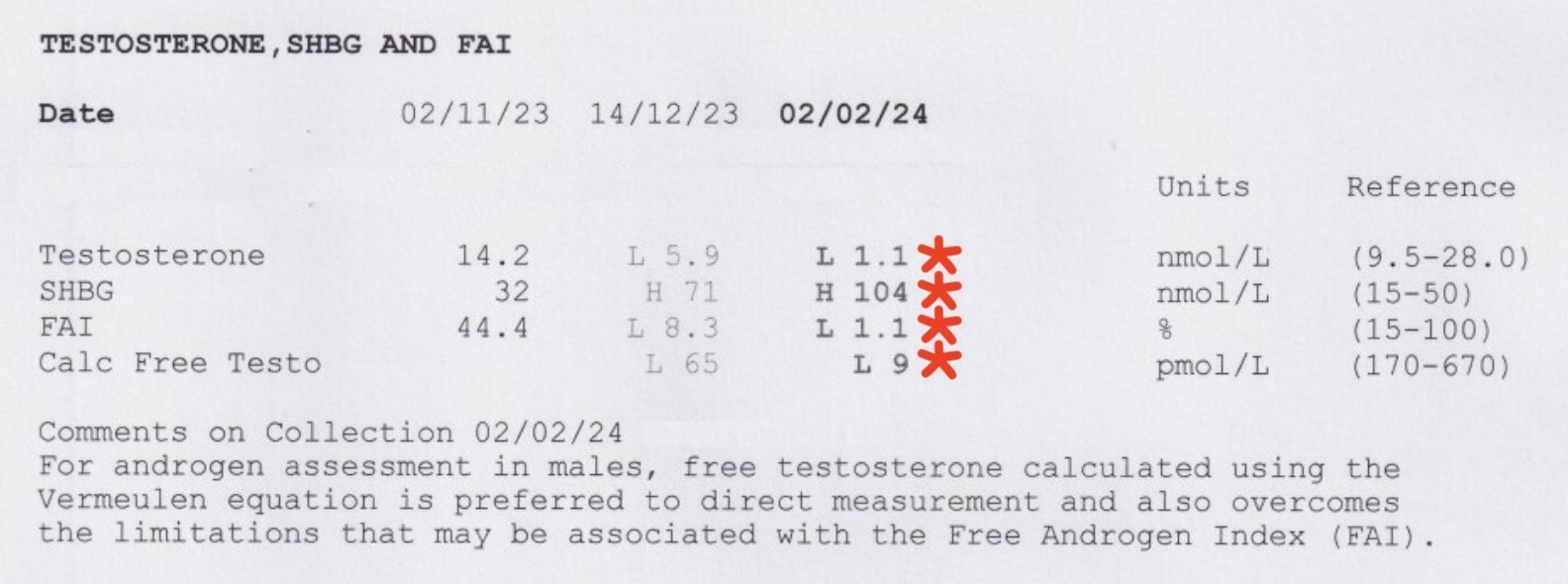
Oh there it is, testosterone down to 1.1 nmol/L. It was flagged low against the male reference range printed on the report, which wasn’t the range I was aiming for during feminising treatment. My sex hormone-binding globulin (SHBG) had risen from 32 to 71 to 104 nmol/L. Oral estrogen can raise SHBG. I couldn’t find the document behind my old 115 nmol/L claim, and there isn’t a switch at that number where estrogen suddenly starts being bound. From Wikipedia:
The relative binding affinity of various sex steroids for SHBG is dihydrotestosterone (DHT) > testosterone > androstenediol > estradiol > estrone. DHT binds to SHBG with about 5 times the affinity of testosterone and about 20 times the affinity of estradiol.
SHBG binds testosterone, DHT and estradiol, with different affinities. It changes the relationship between total and free hormone concentrations, but it doesn’t simply remove the male hormones first or make DHT disappear. “The higher the better” was not a sound conclusion. My total testosterone was low; that alone didn’t establish what DHT was doing.
The calculated free testosterone was also low, recorded as 9 pmol/L on this test. I found the testosterone results encouraging, but decisions about blockers or hair-loss treatment still depend on my goals, symptoms and clinical review. I really do enjoy digging into this sort of data and getting a better understanding of what it means. So that’s it for now. I look forward to my next set of results sometime in May. 🙃
Sources
- UCSF - Overview of feminizing hormone therapy
- Australian Prescriber - Prescribing for transgender patients
- Spirulina supplementation improves bone structural strength and stiffness in streptozocin-induced diabetic rats
- Influence of Estrogen Therapy on Calcium, Phosphorus, and Other Regulatory Hormones in Postmenopausal Women: The MESA Study
- Iron absorption from supplements is greater with alternate day than with consecutive day dosing in iron-deficient anemic women
- The Efficacy and Safety of Vitamin C for Iron Supplementation in Adult Patients With Iron Deficiency Anemia: A Randomized Clinical Trial
- LactMed - Milk Thistle
- MedlinePlus - Serum progesterone
- Effects of low-dose oral micronised progesterone on sleep, psychological distress, and breast development in transgender individuals undergoing feminising hormone therapy: a prospective controlled study
- National Cancer Institute - Pregabalin
- DailyMed - Finasteride tablet prescribing information