 Nix McRetro
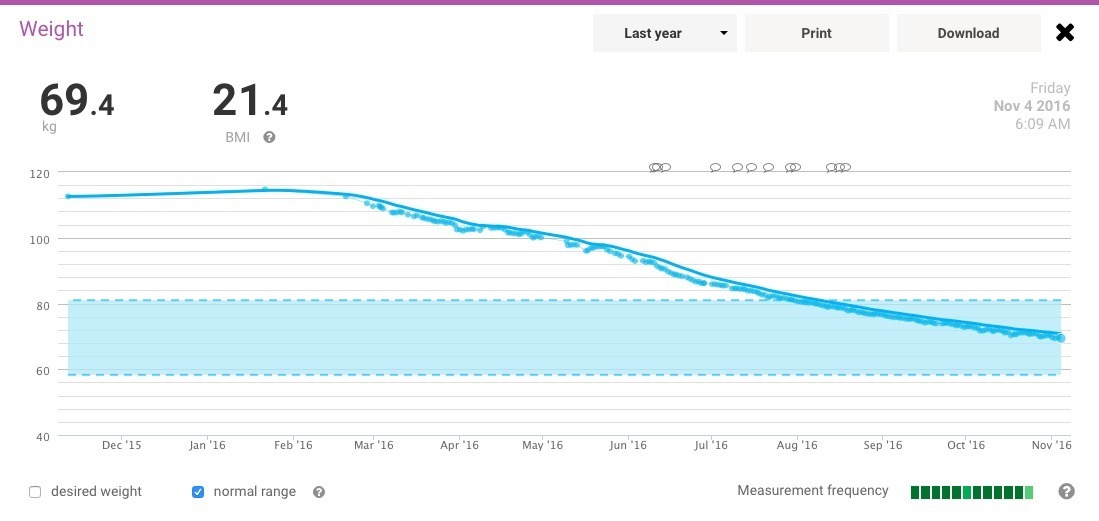
Now that I’ve lost over 45kg from my starting weight of 114.7kg, I wanted to write down the main things I had been doing. I’m not a medical doctor of any sort. This is a record of my own 2016 weight-loss experiment, not a diet plan for anyone else.
At the time I had reduced daily energy expenditure to a neat 70% “keeping the body alive”, 20% exercise and 10% digestion. Real physiology is not that tidy, so I would not use those numbers as a rule. What mattered to my experiment was that I was consistently eating less energy than I was using.
Over those ten months I was typically eating around 50% of the daily energy figure I was using earlier on, moving closer to 60-70% later. As I lost weight, that estimated energy requirement also fell. Looking back, that was a large deficit and should be read as what I did, not something somebody else should copy.
My own macronutrient split was usually around 40-50% of energy from fat, 20% from carbohydrates and 30% from protein. Those were my numbers, not magic ratios. Fat contains considerably more energy per gram than carbohydrate or protein. And alcohol? It has more energy in it than life itself.
Protein was something I paid a lot of attention to. I was usually somewhere between about 64g and 120g per day, split across three meals. I had worried that “too much protein” automatically damaged healthy kidneys, but that blanket statement was too broad. Protein needs depend on the person, and people with kidney disease can have different requirements that should be worked out with their clinician or dietitian.
Fats were useful for keeping me satisfied, but my old ranking of polyunsaturated fats as “best”, followed by monounsaturated fats, was far too simple. The useful general point is to limit saturated fat and favour foods containing unsaturated fats.
Carbohydrates were another thing I simplified too much. I tended to favour lower-GI foods and avoid a lot of added sugar, but “sugar carbs are bad, non-sugar carbs are good” is not a useful universal rule. GI is only one property of a food, and the path from diet to insulin resistance and type 2 diabetes is considerably more complicated than the one-line chain I wrote here.
Vitamins and minerals were probably the weakest part of what I was doing. I was eating very little fruit or vegetables because I found them inconvenient and they didn’t appeal to me much. I’ve always been a bit like that. Hitting numbers on a nutrition tracker is not the same thing as eating a varied diet, so that is one part of the 2016 experiment I definitely would not present as advice.
My diet was boring - chicken, salmon, toast and milk - and it certainly accompanied a lot of weight loss. Hopefully this is more useful as a record of what I actually did than as a set of instructions for somebody else. :)