 Nix McRetro
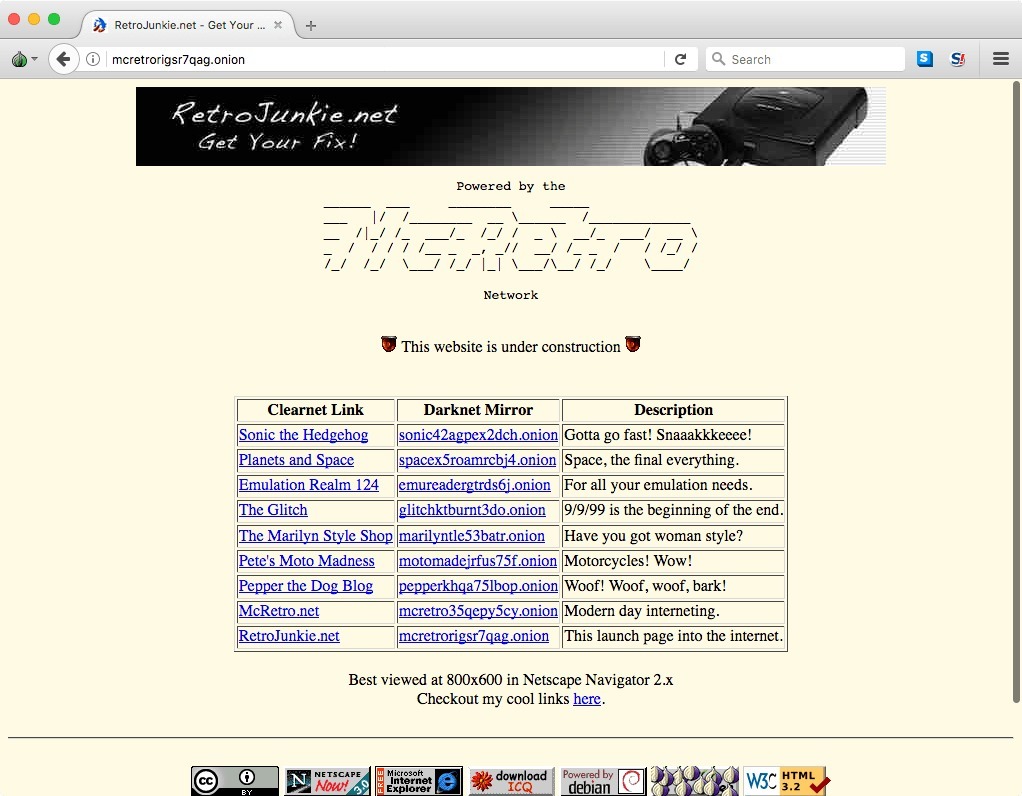
I love to tinker and with my website, I’ve been doing a whole lot of it over the past few weeks. First, I fixed all the broken links and images. Then I went through and cleaned up each post, which had become mangled from an import many eons ago. Finally, I got SSL working again through Certbot.
And now? I’ve got the darknet websites working again! I’ve established RetroJunkie.net and its darknet mirror mcretrorigsr7qag.onion to be a landing page on what will one day be a bunch of websites coded by hand that will be viewable on very old hardware - think early versions of Netscape and Internet Explorer. Maybe not initial HTML1 but closer to HTML3.2. That’ll put us smack bang in the mid-90s - which is fantastic!
It’s also a great idea to dilute the darknet of scary websites as Some Ordinary Gamers have shown us on their YouTube channel. Quite fun to configure at the very least! :D
If you want to know more about digital online anonymity and privacy, jump over to The Electronic Frontier Foundation with their great write-up on how HTTPS and Tor work together to achieve just that.
I still need to see if I can get SSL enabled on onion sites, but I’ll leave that for another day I think! ;)
Later clarification: I had the right practical conclusion for the wrong technical reason. Tor onion services do not “use SSL” underneath. The onion-service protocol already provides end-to-end encryption and authenticates the onion address, so an HTTPS certificate is not required merely to stop the Tor connection being plaintext. HTTPS can still be layered on top for other reasons.
The 16-character onion address I was using here was a version 2 onion address. Tor later retired v2 onion services, so that historical address is no longer expected to work. Scallion belongs to that old v2 vanity-address era as well and should not be presented as a current recommendation.
This eventually continued in The Darknet Revisited.