 Nix McRetro
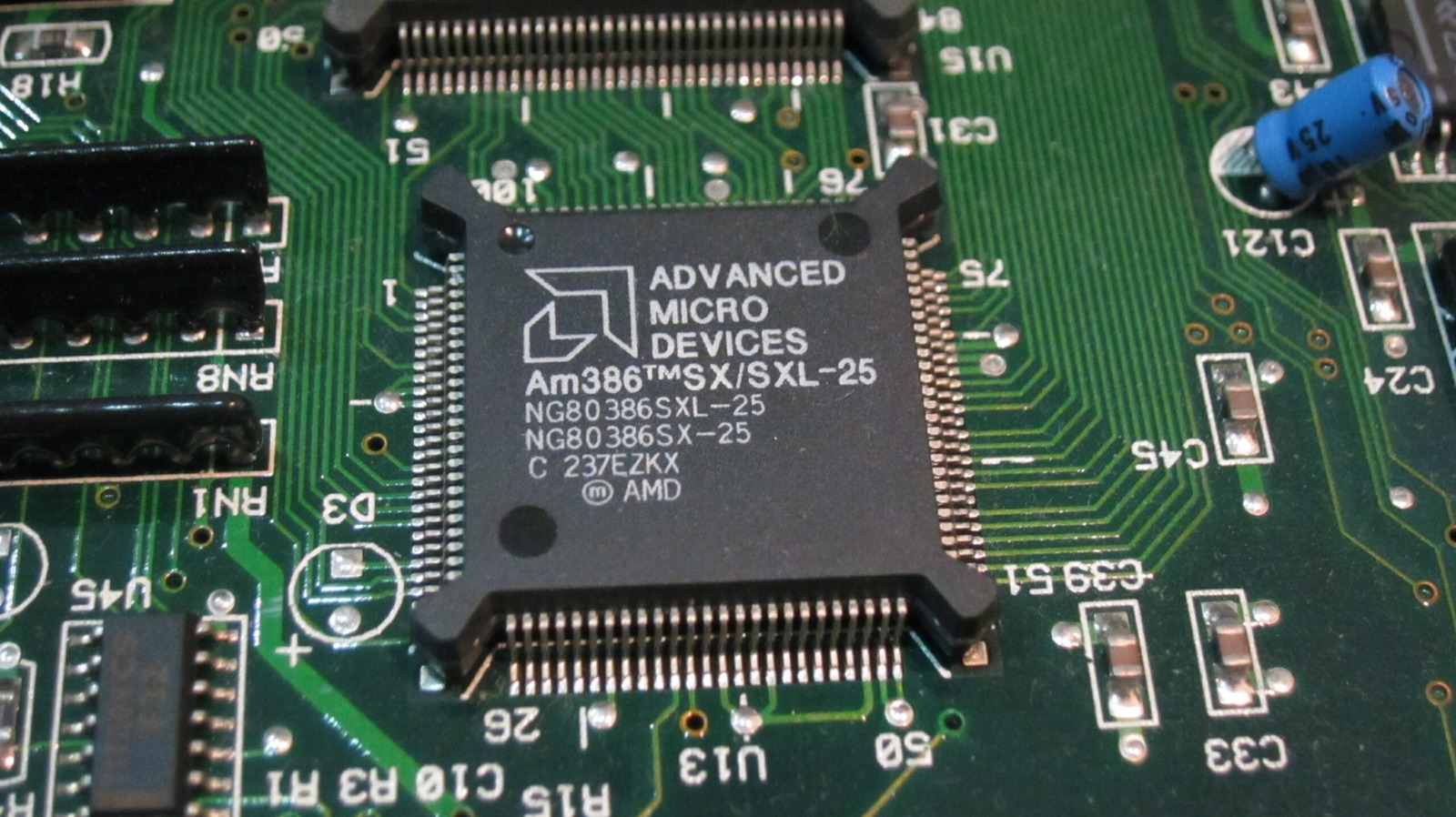
The time has come. We wish you a safe journey, AMD 386SX CPU. You have served us well. Armed with a heat gun and flux, work begins on my attempt to create a 50 MHz Amstrad Mega PC.
That 50 MHz target needs a little explanation. The original Am386SX does not run its core at the full CLK2 input frequency. A 50 MHz CLK2 signal corresponds to a 25 MHz 386SX core. The replacement chip shown in the later repair photographs is marked TI486SXLC2-G50-PQ. It belongs to TI’s clock-doubled SXLC2-G family, designed for a 50 MHz internal core from a 25 MHz external bus in a 100-pin QFP package. So the idea was not to force the entire Mega PC motherboard to run at a 50 MHz external bus speed.
Looking back, similar clocks and packaging do not automatically make a CPU a drop-in replacement. The SXLC2-G needs a 3.3 V core supply, despite having 5 V-tolerant I/O. The supply voltages, motherboard chipset, BIOS, cache-control signals, pin compatibility and surrounding circuitry all have to cooperate as well.
This was very much an experiment.
I was also using a general-purpose heat gun for the removal. Having now spent more time doing this sort of work, controlled hot-air rework equipment with proper temperature and airflow control is a much better tool for removing a soldered QFP CPU from a vintage multilayer board.
Edit: Everything is on fire! What have I done! Flames everywhere!
Related posts
- 286, 386SX and 486SLC Overclocking and Upgrade Ideas
- Amstrad Sega Mega PC 486SXLC CPU Upgrade Failure
Sources
- AMD Am386SX/SXL/SXLV datasheet - documents the Am386SX operating frequency as half the CLK2 input frequency.
- Texas Instruments TI486SXLC and TI486SXL Microprocessors Reference Guide - documents SXLC2 clock doubling and the distinction between core and bus frequencies.
- Texas Instruments - Designing With the TI486SXL2-G: Converting Existing 486-Based Microprocessor Designs - explains the SXLC2-G family’s 3.3 V core supply, 5 V-tolerant I/O and required hardware changes.